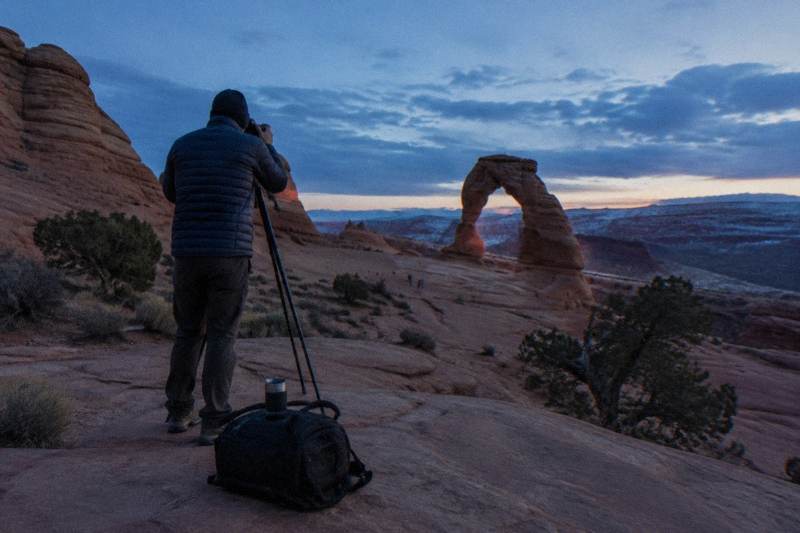
Arches National Park Photography Tours: Where The Light Works
Arches rewards photographers who arrive at the right hour with the right plan. This guide compares the guided tours that suit camera carriers, maps the light windows month by month, and separates what a photo-led day delivers from what a standard sunset tour already covers.
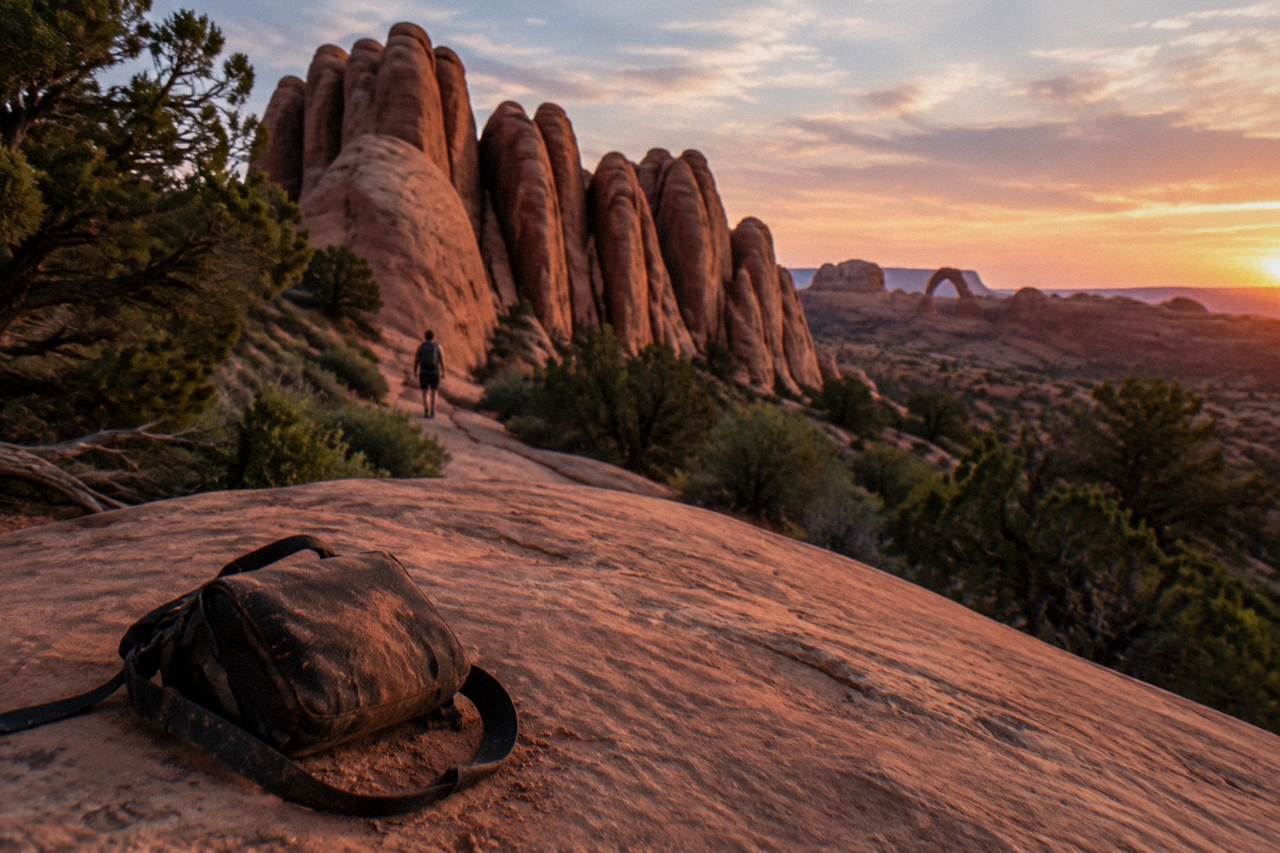
Short answer
A dedicated photo-led day at Arches runs from $425 per person for a photographer-guided, sunrise-to-after-sunset trip for up to 6 guests. The cheaper route is a sunset tour: from $142 for guided walks or $189 for a photography-focused small-group sunset tour with optional stargazing. Park entry is not included on either.
Arches National Park holds more than 2,000 documented arches across 76,519 acres, the densest concentration of natural stone arches in the world, and it draws about 1.5 million visits a year. Photographers make up a large share of that traffic, because the park combines huge sandstone forms with clean desert air and, since its certification as an International Dark Sky Park, a night sky worth staying for. The catch is that the good light and the crowds arrive in the same windows: the NPS warns that between March and October entrance waits may exceed 60 minutes, and that in summer many trailhead lots fill by 7:30 in the morning.
That tension is exactly what a photography tour is built to solve. The right guided option puts a photographer at the right stop at the right hour, with someone else reading the traffic, the parking and the timing. This guide compares what is actually for sale, explains where the light works and when, and sets out the park rules that decide what gear you can legally use. We compared the listings and the official park pages so you can choose between a full photo-led day and a sunset tour that stops at the classic angles.
What Does A Photography Tour Of Arches Actually Give You?
A photography tour gives you three things a standard sightseeing tour does not: timing built around light rather than mileage, a guide who chooses stops for angles and compositions, and in one case a working photographer who teaches camera craft along the way. The premium over a standard tour is real, roughly $250 per person, and it buys a full day rather than four hours.
The clearest example among the tours here is the photographer-led day in Arches and Canyonlands, run from the Moab Information Center by a local photographer guide. It runs a full day, sunrise to after sunset, capped at 6 guests, and is rated 4.9 across 36 reviews, from $425 per person. Water, snack bars and photography tips are included; national park admission is not, so you bring a pass or buy one at the booth. Because the same guide stays with a small group from first light to last, the day is structured around where the sun is, not around a fixed loop.
A standard sunset tour covers less ground but hits the classic angles at the classic hour. The Moab Adventure Center sunset tour with guided walks, from $142 per person and rated 4.8 across 141 reviews, runs 4 hours and includes a guide, snacks, water and transport, though park entry is not in its includes list, so a pass is needed. The Moab In A Day small-group sunset tour, from $189 per person and rated 5.0 across 118 reviews, is explicitly photography-focused, with a spacious vehicle for gear and cold water refills. Neither is a workshop; both solve the timing problem.
What a photo day delivers, concretely, is decisions. Someone who shoots Arches alone has to pick a sunrise location, gamble on parking, drive the switchbacks twice and then find dinner before returning for stars. A guided photo day collapses that planning into one booking. The trade is cost and control: you shoot what the group shoots, at the pace the group moves. For photographers who know the park already, self-guiding with a Shaka Guide audio drive at from $15.99 per vehicle may beat a tour; for a first visit, a guide earns the fare.
Which Arches Tours Work Best For Photographers?
Three listings fit photographers best: the photographer-led day at $425 per person for full-day, 6-guest camera coaching; the Moab In A Day photography-focused sunset tour at $189 per person, 11 guests max, with optional stargazing; and the Moab Adventure Center sunset walks at $142 per person for the classic angles at golden hour. Each trades price for depth differently.
The table below compares the photo-relevant guided options on this site, using the listing figures. Note what park entry means: only three tours listed on this site include the entrance fee, and none of the three below does, so an America the Beautiful pass or a $30 vehicle fee is on you.
| Tour | Operator | Length | Price | Rating | Group max | Park entry |
|---|---|---|---|---|---|---|
| Photographer-led day in Arches and Canyonlands | Local photographer guide | Full day, sunrise to after sunset | From $425 per person | 4.9 across 36 reviews | 6 | Not included, bring a pass |
| Small-group sunset with optional stargazing | Moab In A Day LLC | 3 hours | From $189 per person | 5.0 across 118 reviews | 11 | Not included, the listing states $15 per person or free for up to 4 with one pass |
| Sunset tour with guided walks | Moab Adventure Center | 4 hours | From $142 per person | 4.8 across 141 reviews | Not stated on the listing | Not included, bring a pass |
| Panoramic van tour | Moab Tourism Center | 4 hours | From $159 per person | 5.0 across 879 reviews | 14 | Included |
| Half-day 4x4 with dinosaur tracks | NAVTEC Expeditions | 4 hours | From $240 per person | 4.8 across 2,059 reviews | 16 | Not included, the listing states $15 per person |
Two of those rows deserve a closer look. The panoramic van tour is not a photography product, but it is the most reviewed sightseeing option in town and its includes list carries the park entrance fee, which simplifies a first visit. The NAVTEC backcountry 4x4 is the opposite: it trades paved overlooks for dirt, reaching terrain most photographers never shoot, and with 4.8 across 2,059 reviews it is the most reviewed tour on this site. Its listing title mentions dinosaur tracks, described as the listing describes them.
The stargazing sunset tour deserves its own paragraph because it is the only tour on this site built with cameras implicitly in mind. Moab In A Day runs it as a photography-focused small-group trip in a spacious vehicle, 3 hours, up to 11 guests, meeting at the Portal Building in Moab, with pickup offered. Since Arches is a certified International Dark Sky Park, an evening that ends after dark doubles the shoot: one golden hour, then a second session under the sky. The option matters here, and the night-sky side of that decision is covered in the stargazing and night tours guide.
Where Does The Light Work Best In Arches?
The three stops photographers plan around are Delicate Arch at sunset, the Windows section at sunrise, and Balanced Rock as a foreground for night skies. Tour itineraries concentrate on the same three, which is why almost every sunset tour listed here stops at the Windows or the Delicate Arch area, and the booking pages list the exact stops.
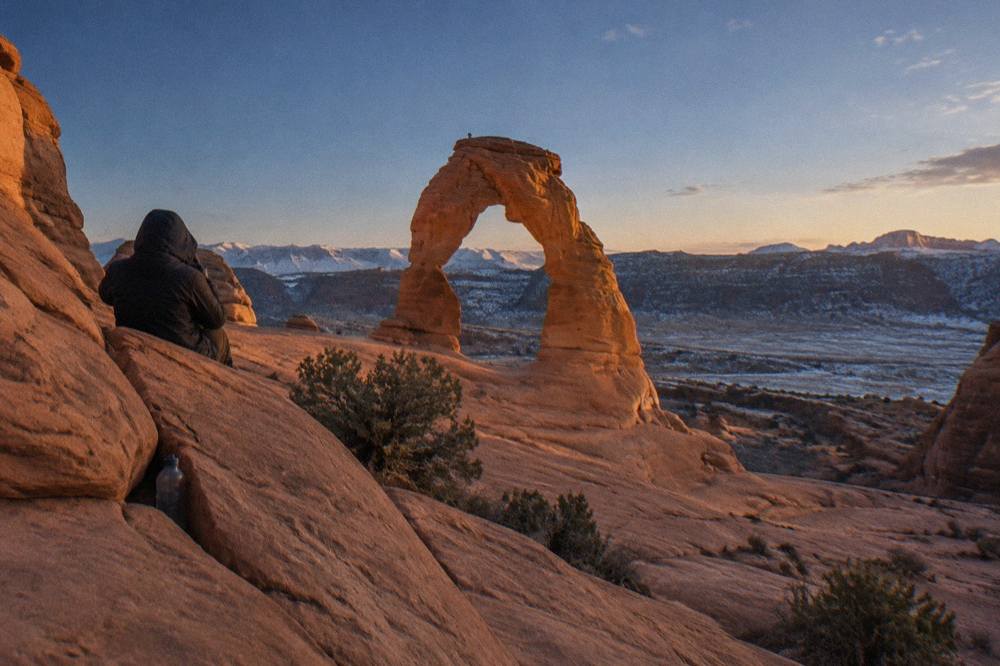
Delicate Arch is the icon, and the NPS numbers explain both its pull and its problem: the trail is 3 miles round trip with a 480 foot climb, past the Wolfe Ranch cabin and a Ute petroglyph wall, to an opening 46 feet high and 32 feet wide, the largest free-standing arch in the park. At sunset, the NPS says, sometimes hundreds of people gather at the arch. Three tours on this site stop at Delicate Arch viewpoints: the sunset guided walks at the Delicate Arch Overlook, the 4x4 sunset and highlights tour and the panoramic van at the Lower Delicate Arch Viewpoint. If you want the arch without the hike, the lower viewpoint is a level 100-yard walk that frames the arch from about a mile away; the upper viewpoint adds a 0.5 mile walk with stairs.
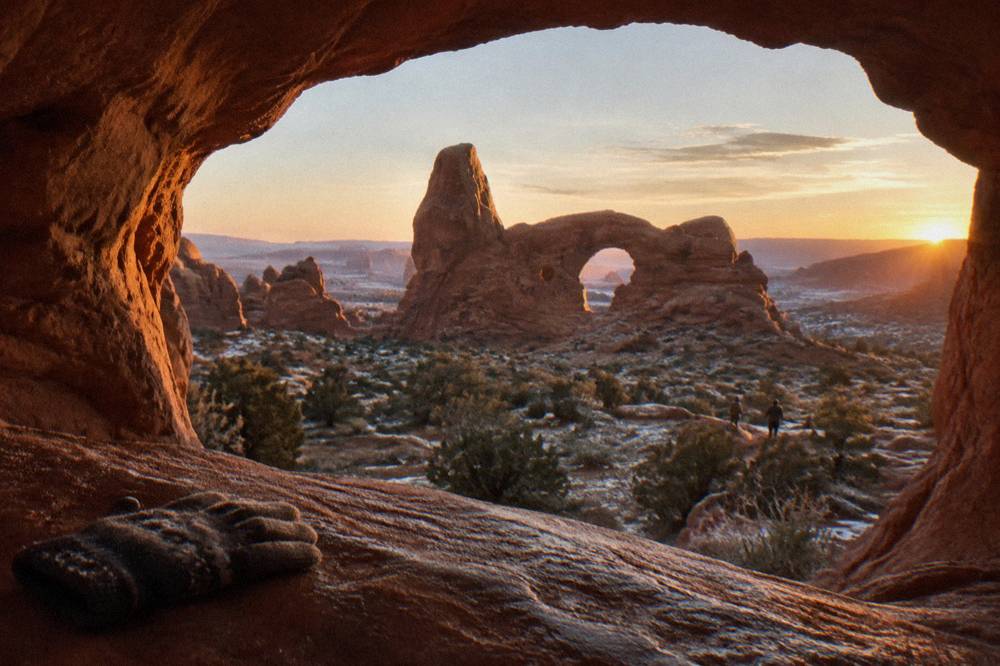
The Windows section, which four of the tours listed here visit, is the sunrise play. East and North Windows face the rising sun, and Turret Arch frames beautifully when shot through them. Balanced Rock, a stop on three tours, sits close to the park road and works as a lit-foreground subject after dark, which matters because Arches prohibits artificial light used to illuminate rock features, so natural composition carries night work. Photography instruction is one of the named categories in the park's Commercial Use Authorization rules, which is why a photographer-led tour here is a licensed activity, not a loophole.
Midday is the hours to write off, and a good tour does exactly that. Between roughly 10 am and 3 pm the sandstone goes flat under overhead sun, entrance lines are longest, and the NPS recommends entering before 8 am or after 3 pm anyway. A full photo day uses midday for travel, Canyonlands angles or scouting; a 3-hour sunset tour simply skips it. If your interest is specifically the arch-and-window stops rather than light itself, the stops on every tour guide breaks each one down.
When Is The Best Light At Arches, Month By Month?
Spring and fall deliver the best photographic conditions: the NPS describes April, May, mid-September and October highs of 60 to 80 F with lows of 30 to 50 F, comfortable hours at both ends of the day. Winter gives the cleanest air and smallest crowds; summer gives violent light, 100 F afternoons and monsoon storms that the NPS warns can cause flash floods.
The NPS almanac gives month-by-month averages that a photographer can plan around. Daily temperature swings can exceed 40 degrees, so the golden hours in every season are also the comfortable hours, and in July and August the only hours worth standing on slickrock are the first and last two.
| Month | Average high / low (F) | Days above 100 F | What it means for the light |
|---|---|---|---|
| Jan | 44 / 22 | 0 | Low winter sun, long raking shadows, possible snow on red rock |
| Feb | 52 / 28 | 0 | Cold golden hours, thin crowds before spring |
| Mar | 64 / 35 | 0 | Busy season begins, entrance waits start building |
| Apr | 71 / 42 | 0 | Prime month, mild mornings and evenings |
| May | 82 / 51 | 1 | Prime month, earlier sunrises mean early starts |
| Jun | 93 / 60 | 6 | Harsh midday, shoot the edges of the day |
| Jul | 100 / 67 | 16 | Extreme heat, monsoon storm cells possible |
| Aug | 97 / 66 | 12 | Monsoon month, dramatic skies but flash-flood risk |
| Sep | 88 / 55 | 1 | Prime from mid-month, storms taper off |
| Oct | 74 / 42 | 0 | Prime, fall color in the washes, dark evenings |
| Nov | 56 / 30 | 0 | Quiet, cold, clean air |
| Dec | 45 / 23 | 0 | Short days, low sun angle, smallest crowds |
Two seasonal warnings come straight from the park's own pages. Even small amounts of snow or ice can make trails and roads impassable in winter, so a winter photo plan needs a weather check, not just a sunrise time. And summer monsoon storms can arrive even when the sky above you is sunny, because flash floods run down from cells miles away; the NPS safety page treats this as a standing July-August hazard, not a rare one. The month-by-month guide on this site covers crowd timing in more depth.
What Gear Can You Bring, And What Is Banned?
Tripods, telephoto lenses and drone-free camera kits are all fine on the trails, but the park bans drones outright, prohibits artificial light used to illuminate rock features, and forbids climbing or walking on any arch. Pets are also barred from trails, which matters for anyone planning a shoot with a dog along.
The drone rule is absolute: the NPS regulations page states you may not use any unmanned aircraft in the park, with no recreational exception. That is why aerial photography of Arches means a permitted airplane tour, not a drone. Redtail Air runs the two airplane tours listed on this site, flying from Canyonlands Field; its 30-minute Arches flight is from $255 per person, rated 5.0 across 44 reviews, and the 80-minute Canyonlands and Arches combo is from $480 per person, rated 4.9 across 131 reviews. Neither involves park entry, so no pass is needed for a flight. If aerial angles are the goal, the scenic flights guide compares them fully.
| Gear or practice | Allowed in Arches? | The rule as the NPS states it |
|---|---|---|
| Tripod on trails | Yes | No restriction on the hiking regulations page |
| Drone | No | Unmanned aircraft prohibited in the park |
| Light painting of rock features | No | Artificial light to illuminate rock features is prohibited |
| Climbing on any arch | No | No climbing or walking on any arch |
| Pets on trails | No | Pets only on roads, in parking areas, campgrounds and picnic areas, leashed |
| Flash for people shots | Generally yes | The ban targets illuminating park features, not route-finding or personal use |
The light-painting ban deserves emphasis because it surprises night photographers. Arches is a certified International Dark Sky Park, which draws astrophotographers precisely because the darkness is protected, and protecting it includes prohibiting lamps and panels aimed at the rock itself. Milky Way and star-trail work here is natural-light work: fast lenses, high ISO, tripods, and compositions that let sandstone sit as a silhouette or catch distant town glow. A ranger program occasionally runs stargazing sessions spring through fall, often near new moon, rotating among the southeast Utah parks; check the park calendar. The wider set of guides lives on Arches National Park Tours.
How Do You Shoot Delicate Arch Without The Crowds?
Sunrise, not sunset, is the crowd answer at Delicate Arch: the NPS notes hundreds of people at the arch for sunset, while the trail is quiet early, though summer trailhead lots fill by 7:30 am so a sunrise shoot means being first in line. Sunset tours deliver the arch in its famous light; a morning tour or an early self-drive delivers it empty.
The trade-offs split cleanly. The sunset guided walks tour stops at the Delicate Arch Overlook, and the 4x4 sunset and highlights tour reaches the Lower Delicate Arch Viewpoint, both timed for golden hour, when the opening faces the low western sky and glows; you share the view with everyone else who had the same idea. The morning tour with guided hikes, from $148 per person and rated 4.9 across 78 reviews, runs the other side of the clock, includes the park entrance fee and offers pickup, which matters when the start time is before dawn.
The middle path is the viewpoint. If the 3-mile hike or the crowd does not appeal, the lower viewpoint is a level 100-yard walk, and the arch reads well from about a mile away with a telephoto. One detail from the NPS page saves a shoot: if the trailhead lot is full and you start from the viewpoint lot, the walk becomes 1 mile along the road, 5 miles round trip total. Plan the parking before planning the composition.
Can You Photograph The Night Sky At Arches?
Yes, and the park is certified for it, but you plan it yourself or book the one sunset tour with an optional stargazing extension. No tour on this site enters the Fiery Furnace at night or anywhere else; commercial tours operate under federal authorization, and night-sky access in Arches is simply the park after dark, open 24 hours a day with a valid pass.
The park's 24-hour access is the quiet advantage: entry is allowed at any time during operating hours, and there is no timed-entry reservation in 2026, so an evening arrival after 3 pm, per the NPS traffic advice, can roll straight into a night session. The Moab In A Day sunset tour's optional stargazing add-on is the only tour on this site that extends past dark with a guide; the photographer-led day runs sunrise to after sunset by design, which puts its final hour in darkness for exactly this reason.
The other night-sky angles are free. The Moab-Arches shuttle ran as a 2026 pilot, free with a valid park pass, seven days a week 8 am to 5 pm, with stops at the visitor center, the Windows area and the Delicate Arch trailhead, and the last Delicate Arch departure at 4:05 pm; 2027 service has not been announced. As a daytime tool it solved parking for an afternoon-to-dark plan, when it ran. For a fuller treatment of dark-sky logistics and the ranger stargazing programs, see the night-sky guide on this site.
How Much Does A Photo Day Cost Compared To Doing It Yourself?
Doing it yourself costs a $30 vehicle pass, good for the vehicle and its occupants, plus fuel and food: the cheapest guided step up is a $15.99-per-vehicle audio tour, and the cheapest guided half day is $139 per person with entry included. A full photographer-led day at $425 per person is the top of the local range, and only worth it if the coaching and the light-chasing schedule matter to you.
The self-guided floor is genuinely low. A Shaka Guide audio driving tour at from $15.99 per vehicle, rated 4.5 across 41 reviews, gives offline maps and narration for everyone in the car, lifetime access included, but no guide and no entry fee. A day-tripper combining that with a $30 vehicle pass has a full flexible day for under $50 plus gas. The gap between that and the $425 photo day is not just guiding; it is a photographer who knows which arch catches first light in October and holds the group there until it does.
| Approach | Cost | Park entry | What you give up |
|---|---|---|---|
| Self-drive plus audio tour | From $15.99 per vehicle plus pass | Separate | Coaching, timing discipline, crowd navigation |
| Sunset guided walks | From $142 per person | Separate, bring a pass | Depth, sunrise, night sky |
| Photography-focused sunset with optional stargazing | From $189 per person | Separate, the listing states $15 per person | Full-day coverage, coaching |
| Photographer-led full day | From $425 per person | Separate, bring a pass | Nothing on this list, only money and flexibility |
| Panoramic van tour | From $159 per person | Included | Photographic pacing, small group |
One more budget line closes the comparison: passes. An annual Arches and Canyonlands pass runs $55 for US citizens and residents, and an America the Beautiful pass covers the $30 vehicle fee or four per-person fees at any federal site, so a multi-park Utah trip changes the math. The full fee schedule and what tour prices do and do not cover is laid out in the entrance-fee guide on this site. Whichever route you take, treat prices here as snapshots and read the live listing before booking: from-prices move with season and demand.
If a sunset tour is the depth you actually need rather than a full photo day, a private option also exists: Moab In A Day runs a private 3-hour sunset tour from $211 per person, rated 5.0 across 21 reviews, meeting at 150 E Center St, which puts the itinerary entirely in your hands. That splits the difference between the group sunset walks and the $425 photo day, and for many photographers it is the sweet spot: your stops, your pace, golden hour only, no coaching overhead.
The honest summary, from comparing the listings side by side, is that Arches National Park Tours like these differ mainly in how much of the day they own. The photographer-led day owns all of it, sunrise to stars. The sunset tours own the best three or four hours. The audio tour owns none of it and leaves the decisions to you. Pick the level of ownership you want, bring a pass where the listing says to, and the light does the rest.
Common Questions About Photography At Arches
Are Drones Allowed For Photography At Arches National Park?
No. The NPS regulations page prohibits all unmanned aircraft in the park, with no recreational exception. Aerial photography of Arches means a permitted airplane tour, such as the 30-minute Redtail Air flight from $255 per person.
Can You Light Paint The Arches At Night?
No. Arches prohibits artificial light used to illuminate rock features. Night photography here is natural-light work: tripod, fast lens, high ISO, with formations as silhouettes or rim-lit subjects.
Which Tour Is Best For Photographers?
The photographer-led day in Arches and Canyonlands, from $425 per person, is the only listing built around camera craft, running sunrise to after sunset for up to 6 guests. Cheaper alternatives are the photography-focused small-group sunset tour from $189 or the sunset guided walks from $142.
Do Photography Tours Include The Park Entrance Fee?
None of the photography-relevant tours includes it. Bring an America the Beautiful pass or buy one at the booth; the NPS lists $30 per private vehicle, valid for the vehicle and its occupants, or $15 per person on foot or bicycle.
When Is The Best Month For Photography At Arches?
April, May, mid-September and October, when NPS average highs run 60 to 80 F and golden-hour temperatures are comfortable. October adds early darkness for night-sky sessions and fall color in the washes.
Can I Photograph Delicate Arch At Sunrise Instead Of Sunset?
Yes, and it is the crowd-avoiding choice; the NPS notes sunset crowds can number in the hundreds. The trail is 3 miles round trip with a 480 foot climb, and in summer the trailhead lot can fill by 7:30 am, so arrive early.