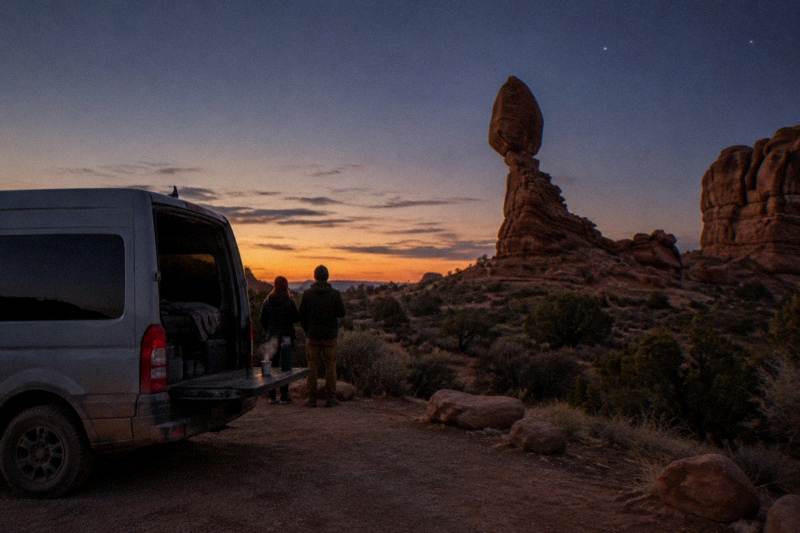
Arches National Park After Dark: Stargazing And Night Tours
Arches is a certified International Dark Sky Park, and the stargazing add-on on the small-group sunset tour is the simplest way to be standing inside it after the sun goes down.
Short answer
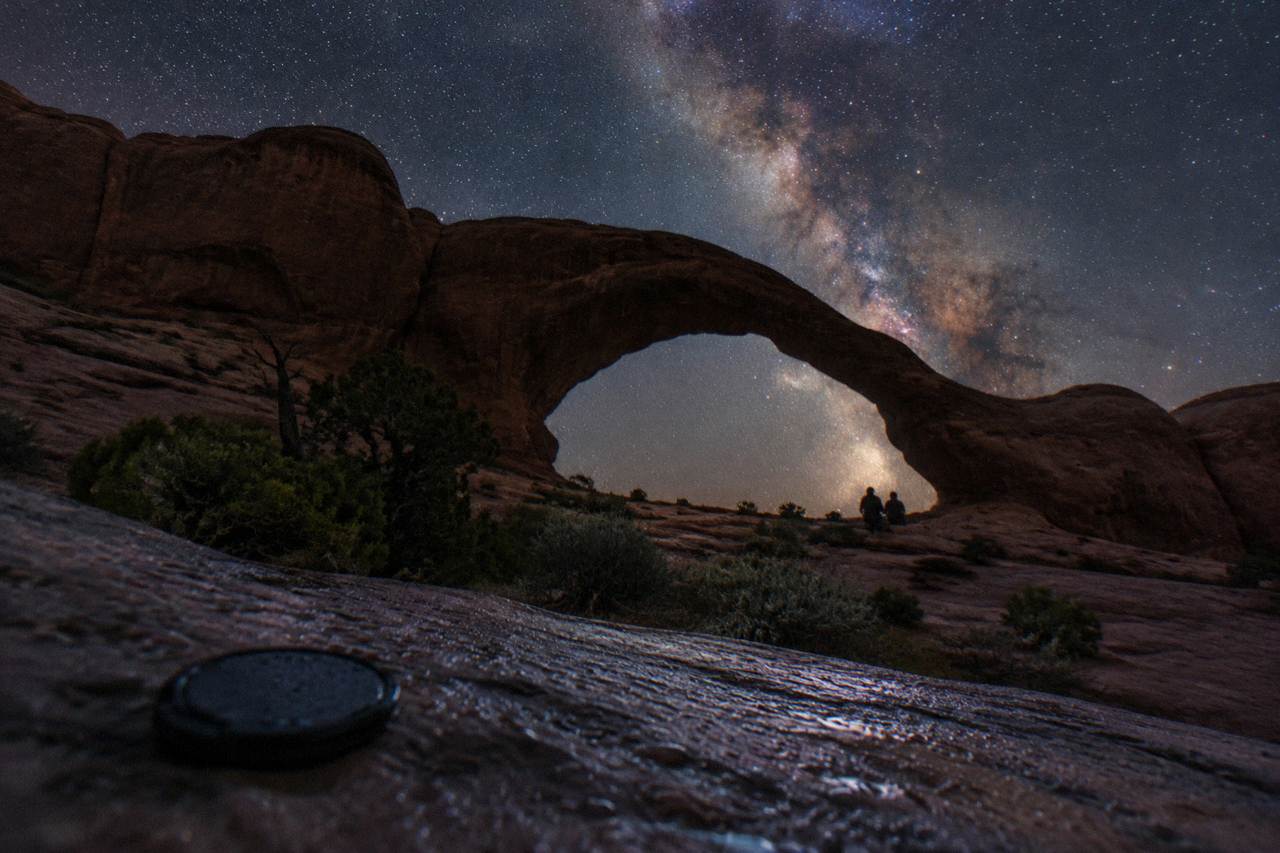
Arches is an International Dark Sky Park with about 1.5 million visits a year, most of them in daylight. The Moab In A Day small-group sunset tour offers an optional stargazing add-on from $189 per person, park entry not included, in groups of 11 or fewer. Nights run cold: average lows drop to 22 F in January and 60 F in June.
Arches National Park sees about 1.5 million visitors a year, and the overwhelming majority of them leave before the sky does anything interesting. The park is certified as an International Dark Sky Park, which is the official recognition that its night sky quality is exceptional, and the NPS actively encourages night sky viewing after hours. The catch is practical: the park road is unlit, desert nights are far colder than desert days, and the rules about light are strict. Night-sky searchers can book the sunset tour with the stargazing add-on instead of arranging it alone, which is exactly the decision this guide works through. Along the way it covers Arches National Park Tours across the sunset and morning tours, the light and pet rules, and what the dark does to the drive back to Moab.
What Is The Stargazing Add-On On Arches Tours?
The stargazing add-on is an optional extension on the Moab In A Day small-group sunset tour, a 3-hour photography-focused outing rated 5.0 across 118 reviews, priced from $189 per person in groups of 11 or fewer, with national park entry not included. Instead of rolling back to Moab the moment the sun drops, the group stays in the park into darkness with a guide who knows where to stop and how long to linger. The listing includes cold water refills and snacks and describes the vehicle as spacious; park entry is stated on the listing as US$15 per person, free for up to four people with one valid pass.
The add-on answers a real problem. Sunset tours that end at dusk put you on the park road right as the sky turns fully dark, and the NPS hours page confirms the park is open 24 hours a day, so there is nothing stopping you from staying. But staying means driving the winding road out yourself at night, with wildlife, unlit pullouts and no services inside the park. There is no public transportation inside Arches at all, and the Moab-Arches Shuttle stops running at 5 p.m. well before any stars appear. A guided evening removes that drive.
Two other evening formats sit beside it. The Moab Adventure Center sunset tour with guided walks, 4 hours, rated 4.8 across 141 reviews and from $142 per person, ends around dusk and asks you to bring a park pass rather than including entry. And the private 3-hour sunset tour from the same Moab In A Day operator, rated 5.0 across 21 reviews from $211 per person, lets a family or couple hold the evening to themselves, with the same park-entry arrangement. Neither is a dedicated astronomy program; the add-on tour is the one built around lingering after dark.
For a wider angle on all the evening options, the sunset tours, spots and timing guide compares every sunset-format listing on the site, and the photography tours where the light works guide covers the photographer-led full day in Arches and Canyonlands for readers chasing light rather than stars.
When Is Milky Way Season At Arches?
The Milky Way core is best placed over the Northern Hemisphere sky from roughly April through October, which overlaps almost exactly with Arches' busy season of March to October, and the NPS says ranger-led stargazing programs run spring through fall, often around new moon. The park itself does not publish a season; it publishes the fact that the sky is worth the trip year-round and that ranger astronomy events rotate among Arches, Canyonlands and Dead Horse Point, per the NPS stargazing pages at nps.gov/thingstodo/arches-stargaze.htm.
The planning variables are moon phase and cloud cover, and only one of them is on a calendar. A bright moon washes out the fainter stars, so the window worth targeting is the several nights around new moon. The NPS weather page records 8 to 10 inches of precipitation a year spread thinly, but late-summer monsoon storm cells can build violently in July and August and the NPS safety pages warn that flash floods can start even under a sunny sky, so a monsoon-season evening plan should always have a fallback. Cloud forecasts matter more here than in most parks simply because the reward is so high when it clears.
Temperature is the variable first-time stargazers underestimate. Daily swings can exceed 40 degrees, so an 88 F September afternoon can deliver a 55 F night, and a 100 F July evening still falls to the 60s before midnight. The month-by-month table below uses the NPS almanac of average overnight lows, and it should be read as averages, not promises: winter nights reach lows of 0 to 20 F and even small amounts of snow or ice can make trails and roads impassable.
| Month | Average low (F) | Days above 100 F | Night-sky note |
|---|---|---|---|
| Jan | 22 | 0 | Core below horizon; hard cold |
| Feb | 28 | 0 | Long nights, quiet park |
| Mar | 35 | 0 | Busy season begins |
| Apr | 42 | 0 | Milky Way core rises late |
| May | 51 | 1 | Comfortable evenings |
| Jun | 60 | 6 | Core well placed |
| Jul | 67 | 16 | Monsoon storm risk |
| Aug | 66 | 12 | Monsoon storm risk |
| Sep | 55 | 1 | Peak comfort, core early |
| Oct | 42 | 0 | Core low after dusk |
| Nov | 30 | 0 | Quiet, cold |
| Dec | 23 | 0 | Longest nights |
Is It Safe To Drive The Park Road At Night?
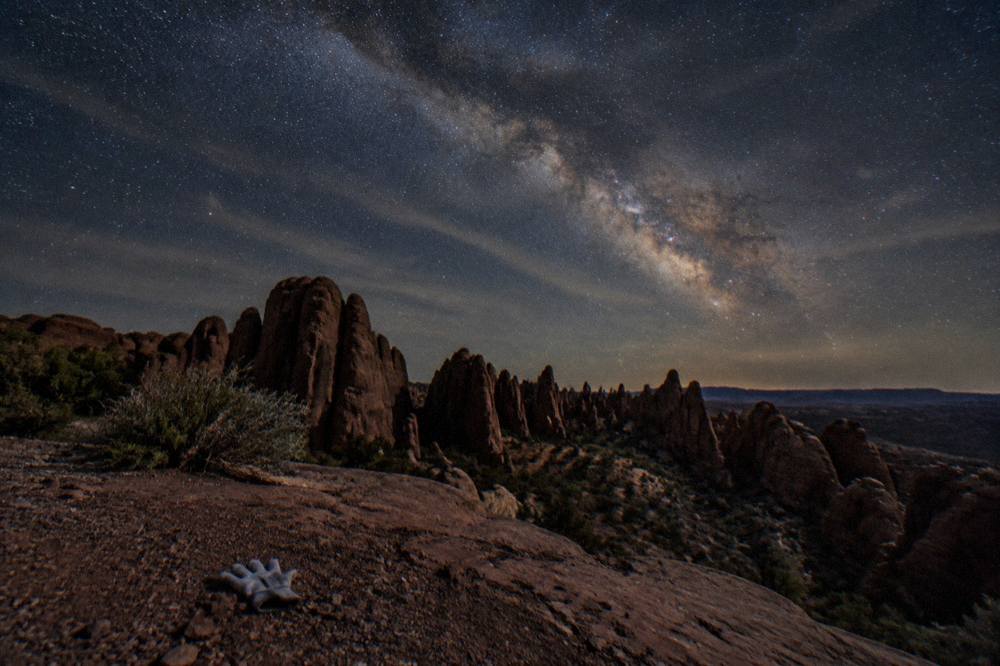
The park road is open 24 hours a day and legally driveable at night, but it is unlit, popular trailhead lots fill by 7:30 am in summer and can force restrictions lasting 3 to 5 hours during the day, and the NPS entrance advisory says waits may exceed 60 minutes between March and October. None of that is a night ban; all of it shapes how much effort an evening visit takes. The entrance is 5 miles north of Moab on US 191, roughly ten minutes from town by the NPS figure, and about 15 minutes from downtown by operator itineraries.
The real night hazards are ordinary ones. Desert roads carry wildlife at dusk and after dark, pullouts are unlit and some sit close to drop-offs, and cell coverage inside the park is unreliable. The congestion rule cuts the other way at night: restrictions happen when lots reach capacity in daylight, so an evening arrival after 3 pm, the NPS-recommended late window, usually finds the lots emptying. Entering before 8 am or after 3 pm is the park's own advice for avoiding traffic.
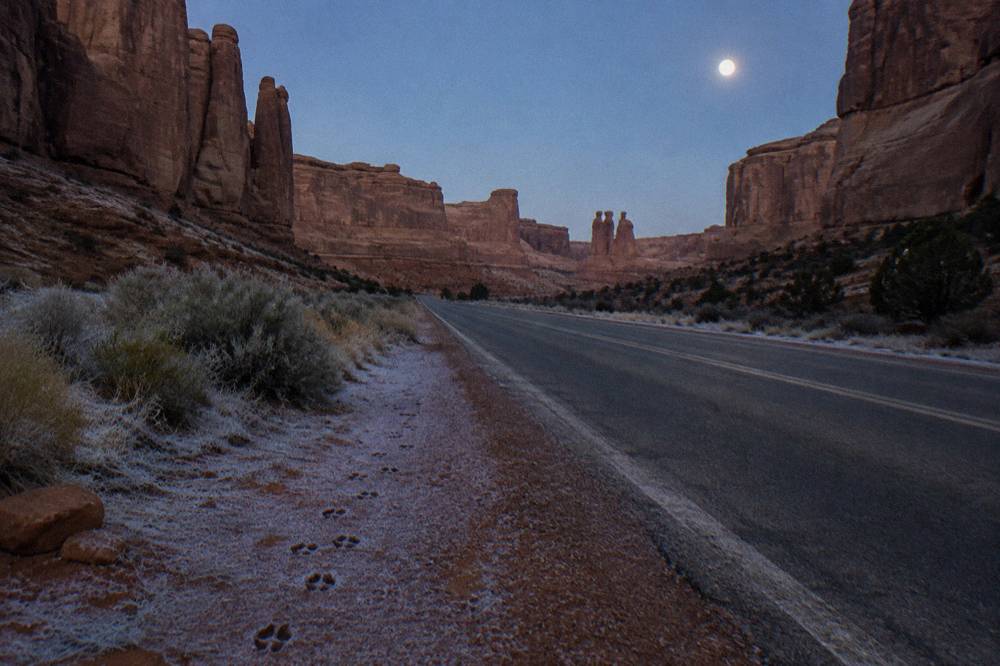
A guided evening hands the driving to someone who runs that road weekly. The small-group sunset tour with the stargazing option uses a dedicated guide and vehicle; the listing states pickup is offered with details on the booking page. That matters more at night than at noon, because the alternative is working an unfamiliar road in the dark with your own headlights and a dashboard glow fighting your night vision.
| Getting there at night | The facts |
|---|---|
| Moab to the entrance | 5 miles on US 191, about 10 to 15 minutes |
| Park hours | Open year-round, 24 hours a day, fees apply |
| Shuttle at night | Moab-Arches Shuttle ends at 5 p.m. |
| Public transit in park | None |
| Daytime congestion | Entrance waits can exceed 60 minutes, March to October |
| Guided option | Stargazing add-on tour, guide drives |
The entrance fee itself is unchanged after dark: $30 per private vehicle, valid for the standard seven days as the NPS fees page describes it, or $15 per person on foot or bicycle, with youth 15 and under free. America the Beautiful passes cover one vehicle fee or four per-person fees, and the fees page lists no non-resident surcharge.
What Are The Light Rules After Dark In Arches?
Park regulations prohibit drones outright, prohibit artificial light used to illuminate rock formations or other park features, and restrict pets to roads, parking areas, campgrounds and picnic areas on a 6-foot leash, with no pets on any trail, so night photography light and night dog walks are both narrower than visitors expect. The regulations page at nps.gov/arch/planyourvisit/regulations.htm carries the drone and light rules, and the pets page carries the leash rules.
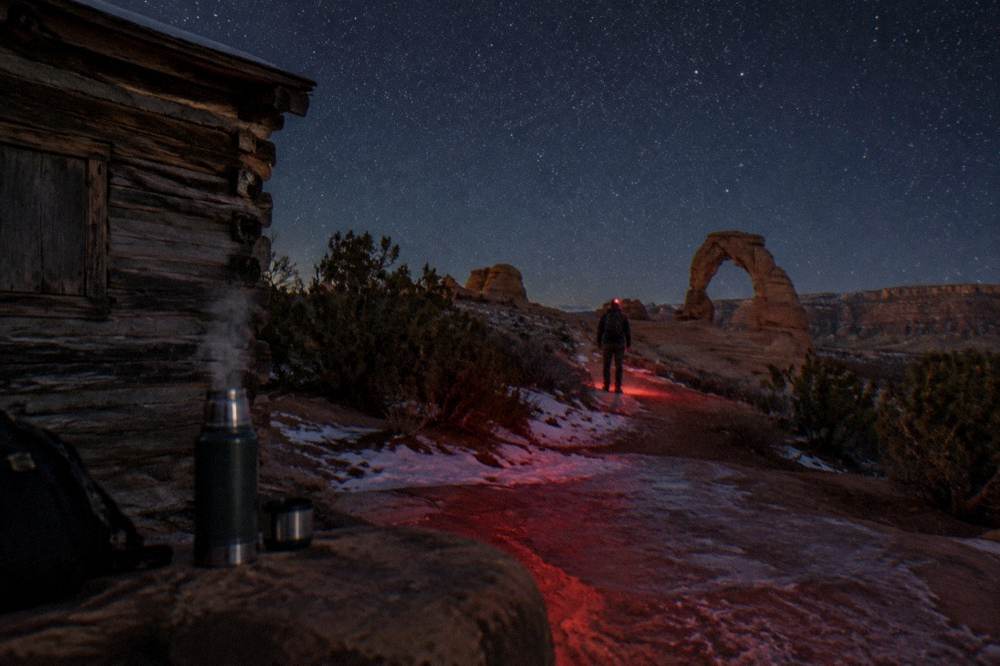
The artificial-light rule is the one that bites photographers. Lighting up an arch with a lamp or flash panel is not permitted; light is allowed for personal route-finding and minimum-impact camping, which is why a headlamp with a red-light mode is the standard kit. Red light preserves the adapted night vision that takes twenty minutes or more to build and minutes to destroy, which is also why tour groups that stay after dark are asked to keep flashlights pointed down.
Drones matter here because Arches from the air at night is a shot people ask for, and the answer is no, unmanned aircraft are prohibited without superintendent approval. The permitted aerial alternative is Redtail Air's scenic flights, which operate in daylight: the 30-minute Arches flight from $255 per person, rated 5.0 across 44 reviews, and the 80-minute Canyonlands and Arches combo from $480 per person, rated 4.9 across 131 reviews. Both meet at Canyonlands Field Airport, 11 miles from the park entrance, and neither involves night flying, so treat them as a daylight complement rather than a stargazing substitute.
| After-dark rule | What the park states |
|---|---|
| Drones | Prohibited, no recreational exceptions |
| Artificial light on rock features | Prohibited |
| Light for route-finding | Allowed |
| Pets on trails | Not allowed, day or night |
| Pets on roads and lots | Leashed, 6 feet or shorter |
| Climbing arches | Not allowed, on any arch |
Where Should You Set Up For The Night Sky At Arches?
The fresh NPS stargazing guidance points to spots like Panorama Point, and the standard logic is a wide-open horizon with a short walk from the car, so overlooks and large pullouts along the paved park road beat trailhead lots hemmed by sandstone fins. The park certifies the sky park-wide; it does not certify viewpoints, so any recommendation is about horizon width, safety and how far you walk in the dark, not about one privileged patch of sky.
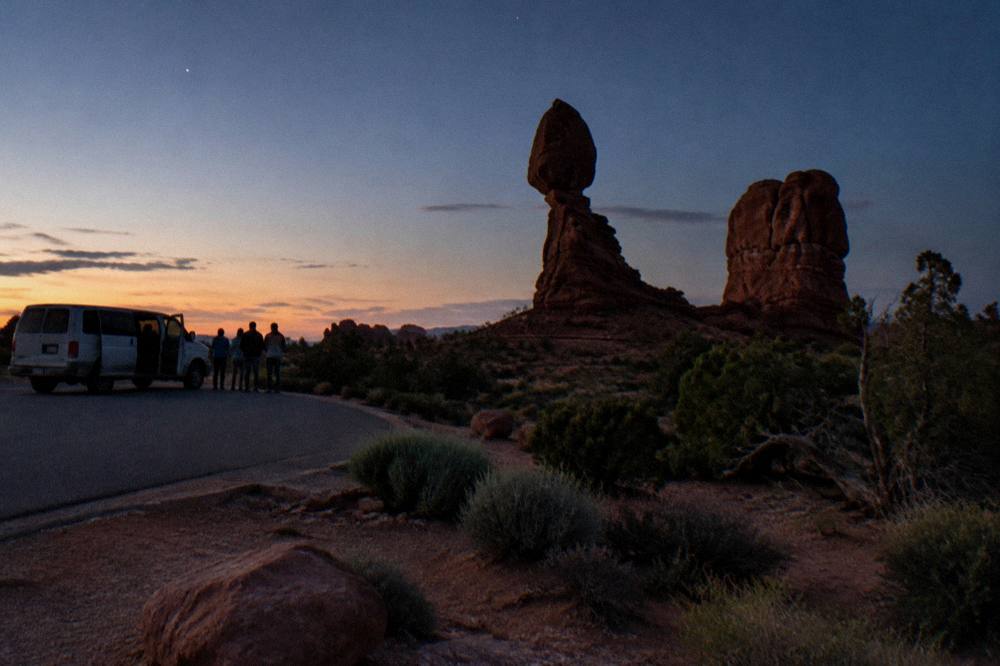
Practical factors narrow it. A site near the road keeps the retreat easy when cold sets in. A site away from the entrance side of the park gets less glow from Moab. And a site you have seen in daylight is far safer to return to after dark than one you are finding for the first time by headlamp, which is an argument for scouting on a daytime tour first: the panoramic van tour from the Moab Tourism Center, 4 hours, rated 5.0 across 879 reviews from $159 per person with park entry included, covers Windows and Balanced Rock, both stops its itinerary names.
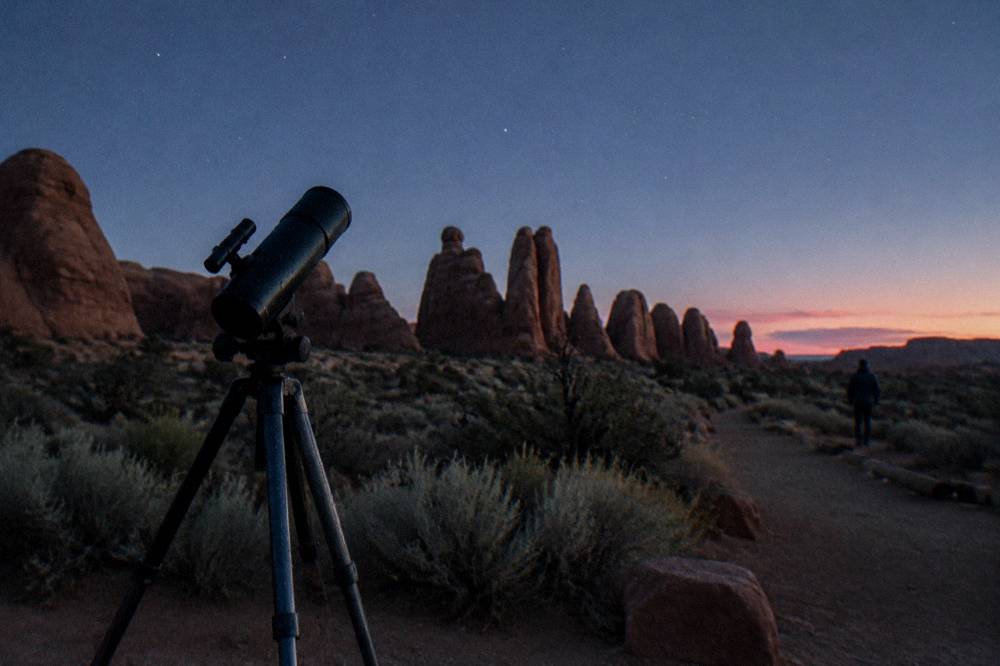
The guided route skips the scouting problem entirely. The stargazing add-on keeps the group with a guide who selects the stop, times the departure, and drives out, and the private sunset tour gives the same outcome for one party, which for families with early bedtimes or photographers with specific frames can be worth its from-$211 per person price. Readers weighing that trade in depth will find the costs broken out in when a private guide is worth it.
One caution applies everywhere at night: stick to paved and established surfaces. Off-trail travel in the dark is how ankles get turned, and the NPS safety pages count twisted ankles and getting lost among the reasons rangers respond to hundreds of search and rescue incidents a year, many involving heat and disorientation rather than cliffs.
What Should You Wear And Bring For Stargazing?
Dress for the almanac low, not the afternoon high, because daily temperature swings can exceed 40 degrees, summer nights commonly settle into the 60s and winter nights reach 0 to 20 F, and the essentials are layers, a red-light headlamp, water and something insulated to sit on. The NPS almanac gives the numbers: June averages a low of 60 F, September 55 F, October 42 F, and by December 23 F. Rain is rare, 8 to 10 inches a year, but a monsoon-season shell is cheap insurance in July and August when the NPS warns violent storm cells can form quickly.
Water still matters at night in the desert, even in cold. The park's own ranger programs set the benchmark, requiring at least one quart or liter of water per person for the Fiery Furnace walk, and while no stargazing stop approaches that exertion, the standard is a useful one to copy. Snacks are on the add-on tour's includes list already; independent visitors should bring their own since the park has no food service and Moab is a drive away.
| Kit item | Why it matters after dark |
|---|---|
| Red-light headlamp | Preserves night vision; white light is for emergencies |
| Insulated layers | Overnight lows 20 to 40 degrees below afternoon highs |
| Sit pad or camp chairs | Sandstone holds the day's cold |
| Water, one liter or more | Desert air, year-round |
| Snacks | No food service inside the park |
| Blanket | Wind at open overlooks |
Photographers should add the obvious: a tripod, since arch-plus-stars exposures run many seconds, and patience with the artificial-light rule, since no lamp may be used to paint a rock feature. The NPS stargazing page is the source to check for ranger-led astronomy events, which run spring through fall and rotate among the southeast Utah parks.
Guided Evening Or Do It Yourself: Which Fits Your Trip?
A guided evening wins on the drive, the light discipline and the timing, from $142 for the sunset walks tour to $189 for the stargazing add-on to $211 for a private sunset, while doing it yourself costs only the $30 vehicle pass and whatever gear you own, and wins only if you are confident on an unlit mountain road at night. The honest split is not about money, which favors the independent route, but about how much of the evening you want to spend managing logistics instead of looking up.
The guided side has real spread. The Moab Adventure Center sunset tour with guided walks is the value entry at from $142 per person, 4 hours, rated 4.8 across 141 reviews, meeting at 225 S Main St with snacks and water included and entry to be carried as a pass. The Moab In A Day stargazing add-on tour is the only one on this site built around the after-dark hour. The private sunset covers the same ground for one booking. A cheaper daytime alternative for context: the self-guided audio tours run from $15.99 to $24.99 per vehicle, cover everyone in the car, but end when you stop driving, and the audio guide versus guided tour comparison works through that trade in full.
Timing the whole day matters as much as the choice. The NPS recommends entering before 8 am or after 3 pm, and the sky rewards the second window twice: once at sunset and again an hour later when true darkness lands. For readers pairing an evening here with other parks on one trip, the Arches and Canyonlands combo comparison covers the full-day 4x4 and three-parks listings that end at dusk and hand you back your own night.
However you arrange it, check the NPS conditions page before you go, since conditions change and the alerts page is the authoritative source, and book the evening listing early in the busy March-to-October window, when entrance waits alone can exceed an hour.
Common Questions About Stargazing At Arches
Can You See The Milky Way At Arches National Park?
Yes. Arches is a certified International Dark Sky Park with low light pollution and 8 to 10 inches of annual precipitation, so clear nights are common. The Milky Way core is best placed from roughly April through October, and the sky is darkest on nights around a new moon.
Do I Need A Permit To Stargaze At Arches?
No permit is needed to stargaze from roads, pullouts or overlooks. The park is open 24 hours a day and a standard entrance pass, $30 per vehicle, covers entry. Reservations in 2026 are only required for Devils Garden Campground and Fiery Furnace hikes.
Which Tour Includes Stargazing At Arches?
The Moab In A Day small-group sunset tour offers an optional stargazing add-on. It runs 3 hours, is rated 5.0 across 118 reviews, costs from $189 per person, and takes up to 11 guests. National park entry is not included; the listing states $15 per person, free for up to four with one valid pass.
Is Arches Open At Night?
Yes, the park is open year-round, 24 hours a day, fees apply. The visitor center closes in the evening and there is no public transportation inside the park, and the Moab-Arches Shuttle ends service at 5 p.m., so a night visit means your own vehicle or a guided tour.
What Should I Bring For Stargazing At Arches?
Warm layers for overnight lows that can sit 40 degrees below the afternoon high, a headlamp with a red-light mode, water, snacks and something insulated to sit on. Note that artificial light may not be used to illuminate rock formations, and drones are prohibited.
Is It Cold Stargazing At Arches?
Usually, yes. Average overnight lows run from the 60s F in midsummer to the 20s F in winter, and open overlooks add wind chill. Dress for the almanac low rather than the daytime high, especially from October through April.